




Day for Consecrated Life
Diocesan celebration presided over by His Excellency the Archbishop
4.30 p.m. – 7.30 p.m.
SUNDAY 1 FEBRUARY
Eucharistic celebrations 7:00 a.m. – 8:00 a.m. – 9:30 a.m. – 11:00 a.m. – 12:30 p.m. – 5:30 p.m.
– 10.30 a.m. Morning Praise
– 4.30 p.m. First Vespers of the Feast of the Presentation of the Lord
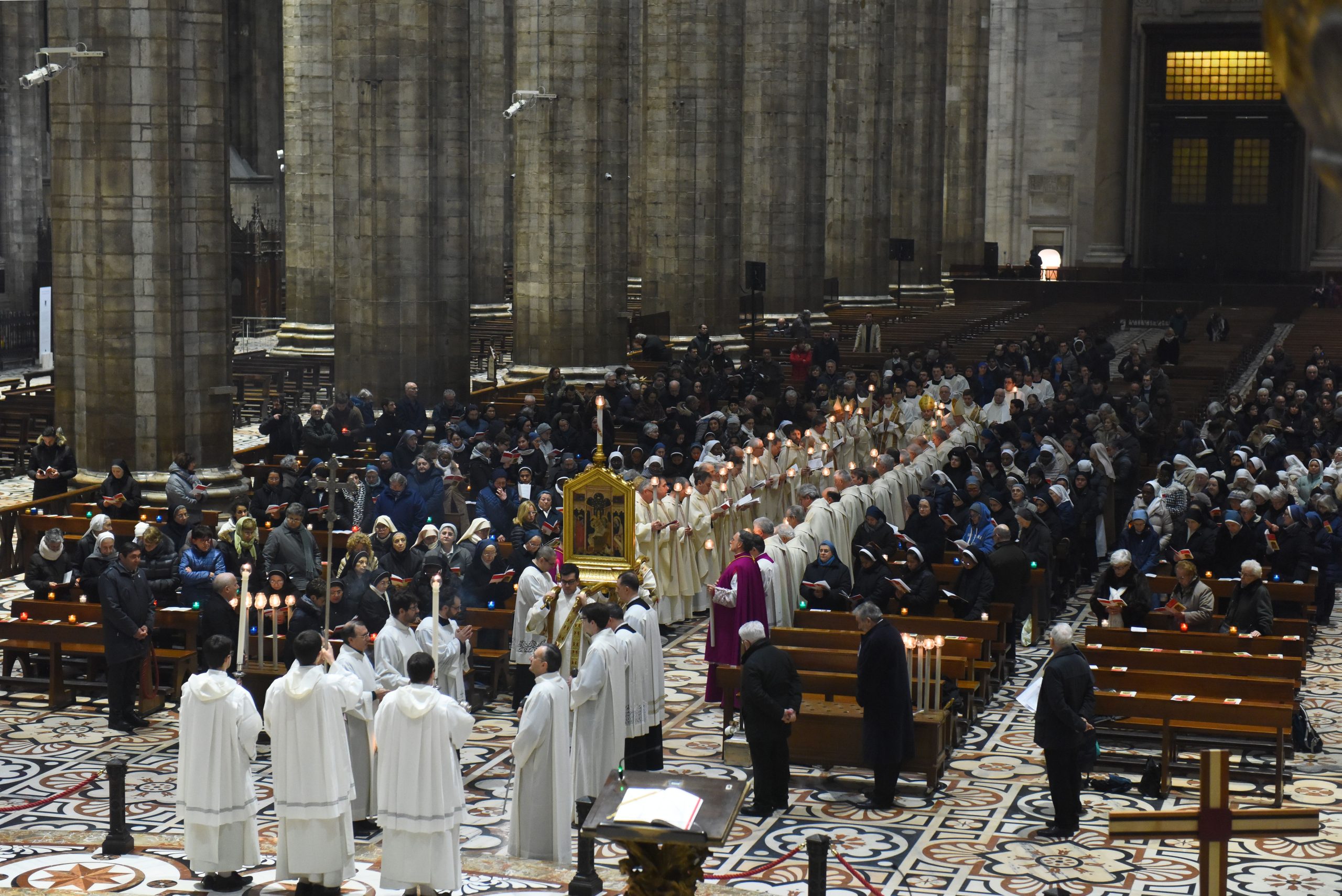
– 5.30 p.m. Blessing of candles, Procession with the icon of Our Lady of the Idea and Eucharist presided over by His Excellency the Archbishop on the occasion of World Day of Consecrated Life
You can follow the 9.30 a.m. Eucharistic celebration and the celebration presided over by Archbishop Monsignor Mario Delpini via live streaming on this website (www.duomomilano.it) on the Duomo Milano TV YouTube channel.
A precious bas-relief from the second half of the 12th century, from the ancient church of Santa Maria Beltrade – now in the Archaeological Museum of Castello Sforzesco – allows us to reconstruct the Procession on the feast of the Presentation of the Lord in the Temple (known in popular tradition as Candelora), as it took place in Milan in the Middle Ages.
It depicts two priests carrying a Marian effigy in the shape of a spire, a cleric with the station cross, a deacon carrying the Gospel book, the Archbishop with mitre and crozier, and finally the clergy of the Cathedral with lighted candles.
The name Ídea appears under the Marian effigy and, in fact, even today, the procession known as the Ídea is celebrated in the Cathedral: it is a pointed panel depicting on one side (verso) the Presentation of Jesus in the Temple, with Mary and the elderly Simeon and Anna (protagonists of the Gospel episode proclaimed on this feast day: Luke 2:22-40), and on the other (recto) the Virgin on the throne with the Child. It is the work of Michelino da Besozzo and dates back to the 15th century.
In medieval times, the Procession arrive d at the Cathedral from the church of Santa Maria Beltrade, which stood in the square of the same name, along Via Torino. Nowadays, however, it takes place inside the Cathedral, where the candles distributed to the Canons and the faithful are blessed. A large candle is also lit on top of the spire of the Ídea, as a remnant of an ancient custom of decorating the Cross or sacred images with lit candles as a sign of celebration and honour. During the procession, the Ídea is carried on the shoulders of two deacons on a special stretcher and, at the end, remains on display at the high altar during the Eucharistic celebration.
Scholars have debated at length the origin of the name Ídea given to this Marian image. Some believe it derives from the pagan cult of Magna Mater Ídea, or Cybele, mother of the gods, in whose honour processions were held in ancient times to invoke the fertility of the earth: in this case, we would be faced with the Christianisation of ancient pagan cults through the controversial replacement of Cybele, called Ídea and considered the mother of the gods, with the true Ídea, the Mother of God, Mary Most Holy. Other scholars have found this explanation unconvincing and propose interpreting the term Idea in its etymological Greek meaning: simply “image”.
On Sunday, 1 February, on the eve of World Day for Consecrated Life, at 5.30 p.m., Archbishop Mario Delpini will preside over the Rite of the Blessing of Candles and the Procession with the icon of Madonna dell’Ídea in the Cathedral, followed by Mass, with the participation of the Metropolitan Chapter and the religious men and women of the Diocese.