



 North Transept Spire-G8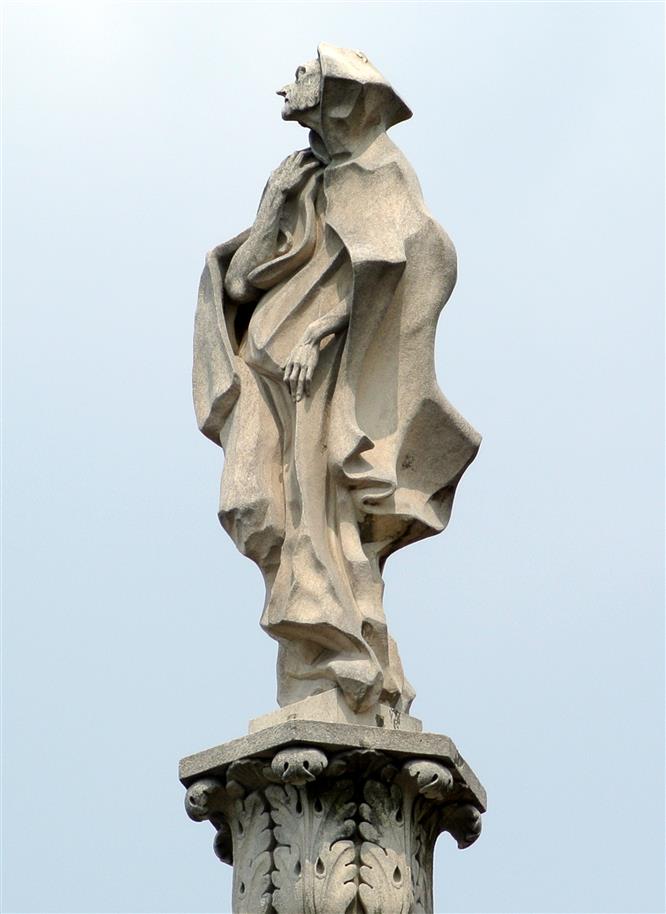
Etymology:
The name Michael derives from the Hebrew Mikha’el and means “Who is like God?”, a rhetorical question about divine uniqueness. It owes its enormous popularity to the cult of the Archangel Michael, a warrior and protector.
Born in Milan in 1427, Michele Carcano joined the Franciscan Order in the convent of Santa Croce in Boscaglia, Como, likely influenced by the sermons of St. Bernardino of Siena. As a promoter of the Franciscan reform, he paired his moral preaching with a strong focus on social action.
He distinguished himself as an extraordinary preacher and a promoter of hospital reform and the effective management of charitable works. Among other achievements, he convinced Francesco Sforza and Bianca Maria Visconti to establish the Ospedale Maggiore, known as the Ca’ Granda. His name is also linked to the establishment of the first Monte di Pietà (pawn shop for the poor) in Perugia in 1462. He traveled there at the invitation of Bishop Ermolao Barbaro, the newly appointed governor of the Umbrian city, who intended for him to preach against usury. The Monti di Pietà of Bologna and other cities soon followed.
After enraging the usurers, he was banished from Milan in 1471. Blessed Carcano died in Lodi in 1484 after suffering a stroke while on the pulpit.
The tales of the statue in the Duomo’s building site:
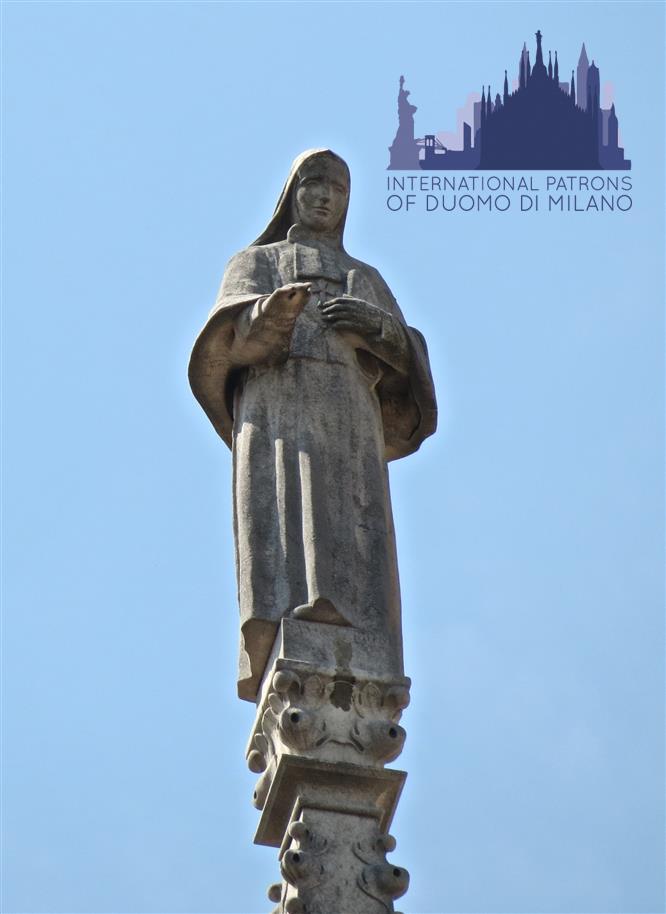
The statue of Blessed Carcano at the top of spire G8 stylistically stands apart from the other statues that crown the Duomo. The profile is not particularly harmonious but is, instead, rather stiff and composed. In fact, it is one of the more recent works produced for the Duomo. Based on the original scale model by Lanfranco Frigeri, the statue was later made by Mario Bassetti in approximately 1951. Blessed Carcano is portrayed hooded and entirely wrapped in a large cloak featuring stiff folds. His thin, sharp face appears from under the hood, looking to the right, towards the east where the sun rises.
 Tiburio