



 07 April
 Facade spire-G14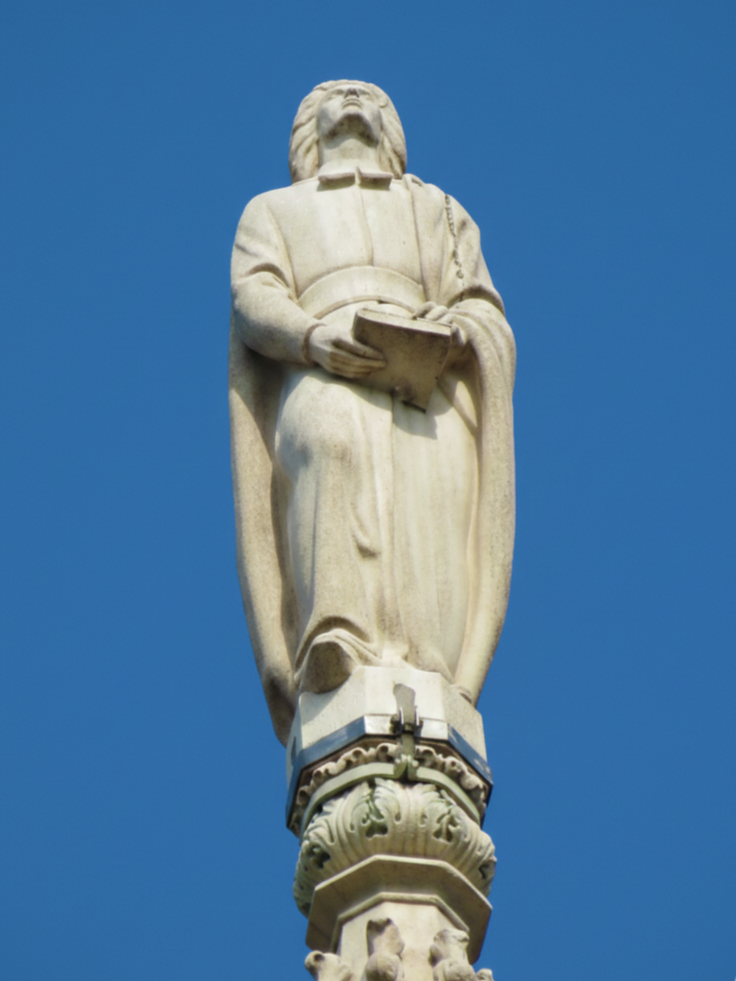
Etymology:
Of Hebrew origin (Yochanan), the name John means “God is merciful.” Thanks to its Greek and Latin adaptations (Ioannes), it has become one of the most widespread and significant names in the Italian tradition.
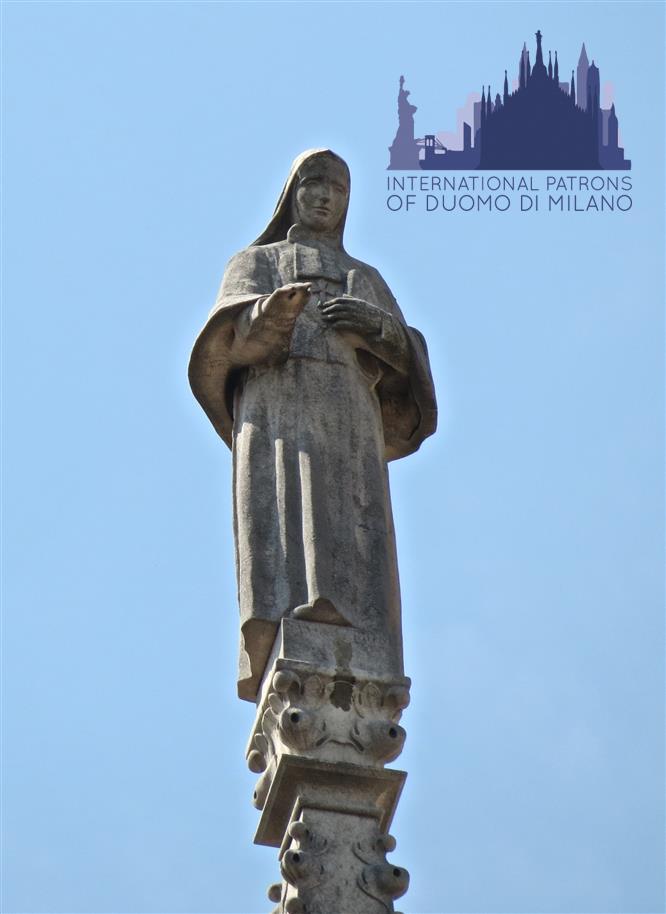
Jean-Baptiste de La Salle (1651–1719) was born in Reims into a noble family. He studied literature and philosophy and became a priest in 1678. He devoted himself to a project of reorganizing schools and education, with the aim of founding public schools accessible to all, starting precisely from the training and reform of teachers. These were gathered into the community of the “Brothers of the Christian Schools,” through which they succeeded in opening additional schools and were called to teach in Paris, where the number of their pupils increased very rapidly.
Due to various criticisms, Jean-Baptiste was forced to move his community to a small town near Rouen, where he died on 7 April 1719. He is remembered as a saint within the Catholic Church for having dedicated his entire life to the education of poor children. His relics were transferred to Rome in 1937, after he had been declared Blessed in 1888 and canonized in 1900 by Pope Leo XIII.
The history of the statue in the Duomo’s construction site:
The statue of Saint John Baptist de La Salle was created around 1952 by the sculptor Di Ceglie; the original model is instead attributed to Nicola Sebastio. The saint is depicted here wearing the typical garments of the Brothers of the Christian Schools, with a long cassock reaching down to the feet, a white bib, and a rustic cloak. He is holding a closed book in his hands.
 Tiburio